Tuesday, November 27, 2007

Bloch redux


(all images courtesy of my lovely wife)

While in KC over Thanksgiving I got a chance to revisit the Bloch building at the Nelson-Atkins fine art museum, this time at night and filled with art. That same night they were hosting a scupture park tour, which is the source of the little bags lighting our way.


The bags highlight something that I hadn't noticed before-- the total absence of streetlighting around the building. The diffuse (but bright) glow that the building itself emits is more than enough to see your way around, and has a wonderful effect upon the contained spaces of the sculpture park-- it becomes a series of comfortable and familiar outdoor rooms instead of threatening surplus space.


The entire effect of the museum, in fact, is very unimposing. One can (and I did) walk up the grass right to the channel glass, and rap your knuckles or slap your palm across the giant lantern. Kids were rolling down hills next to softly lit Moore bronzes. And then there's the fact that admission is free and one can enter the museum at any exterior door, promoting a kind of indoor-outdoor meandering that seems totally foreign to any previous museum experience. Rounding this all out is the fact that, despite the expected occasional slipshod detail or muffed corner, all of the points of human contact in this building-- the handrails, the doors, the floors and paving-- has been deeply considered and is a delight to regard and to touch.


I can't express how ecstatic I am that my hometown made the choice to build this building. This is easily the one of the most boundary-pushing new art museums I've seen, and it does it without grandiose scale, formal histrionics or an exceptional collection. This is, despite all appearences, not a magazine or coffee table museum. It is first and foremost a community asset.

Sunday, November 18, 2007

I'll take mine in "churlish," please

Katy recently heard another photographer cite a web-business adage that I'd never heard before. Apparently, ugly websites sell more. This is not all websites, mind you, but rather websites attempting to aggressively sell something. This photographer had switched print sales sites from one with an elegant interface to one that was markedly uglier, and he saw an immediate uptick in sales. There seem to be a lot of theories about this-- ugly websites are inherently simpler, ugly websites seem more trustworthy, ugly websites usually sell cheaper goods, etc. I have another theory to posit-- that these sites are more approachable, and because they're so bare bones, you feel like you're getting a great deal even if you aren't.

This is the same idea behind bargain retail-- yes, there is usually less overhead in bargain stores, but don't you think that DSW or Filene's Basement makes enough money to, say, put in partitions? Or maybe use lighting that's not ripped directly out of a high school gym? These spaces are not entirely about saving money. They're about creating the atmosphere of savings, replicating as exactly as possible the feeling of a swap meet or flea market, pulling pages out of a book that goes as far back as the Agora.

What is the equivalent domestic atmosphere? Is there some sort of stage set you can produce that will make you seem instantly trustworty? Wise? Fearsome? If so, I'm sure you can buy it at Pottery Barn. It seems like our national industry has become the perfection of atmospherics, or "lifestyles," if you prefer the vernacular. It's not too different from the future Neal Stephenson posits where the only three things the USA is still #1 in are movies, code, and pizza delivery. Not that I'm going to start wailing for a return to honesty and simplicity. But I'd much rather have things reach out and smack you every once in a while, instead of sitting in the corner and glaring. I prefer my design to be active rather than passive. This is not an aesthetic judgement, nor a social one. Maybe just more products that answer the what, how, and why rather than the where, who, and when.

Wednesday, November 14, 2007

back!

So we have returned from our 2-week Normandy/Paris/NYC sojourn (with a brief stop in Cleveland to eat bad airport food). My first post is about the new public bike system we got to see in action in Paris.

They're calling it Velib', a bad french mashup pun, kind of like calling it "bikereedom." Or maybe "cycliberty" In true public transportation style, the logo is hideous:


... and the bikes themselves not too stunning either:


The bikes are, in my opinion, both ugly and slow, but this is probably a plus, as it keeps them from being stolen, and as nobody in Paris wears a helmet, a low maximum speed is pretty necessary. And they work! Each bike has an integral stand, lock, light, and basket. To check one out, you must either have a year Metro pass, or get a special card from the transportation service. Either option requires both a bank account and a physical address in Paris, which makes it difficult for anyone but commuters to get a hold of one. This is irritating if you're a tourist, but with the popularity of these things it's a necessary evil. You get your first half hour for free, with incremental charges afterwards (ramping up such that you probably wouldn't want to have one for longer than an hour and a half). You can return the bike to any stand in the city, which are easily found due to an entirely new street sign system that points the way to the nearest one. The Paris bike lane system has also been massively upgraded and expanded, many of the lanes dedicated with their own curbs.

Did I mention that these things are popular? I would estimate that more than half of the bikes I saw in Paris (and there are many) were Velib bikes. I never saw one visibly broken, never saw one being obviously misused, and 99% of the time there was at least one available bike and one available extra parking spot. While a longer term is certainly needed to give a final verdict on the success of this system, it seems to be working fantastically right now. It's making the Metro less crowded, while adding visual interest to the city and reducing carbon emissions (maybe). Oh, and bikes cannot strike. Why don't these exist anywhere else?

Friday, October 26, 2007

from one dead space to another

I haven't really posted in the last few weeks thanks to an incredible busy weeklong stretch of work to prepare for.... more online absence! Katy and I are taking off two weeks to visit Normandy, Paris, and New York. I'm sure there will be thousands of pictures to follow in mid-November. But for now, all you get is quick ruminations on the lovely wildfires we've had here in Southern California.

1: It has only recently become clear to me that weather conditions exist that can spontaneously start and sustain immense fires. The wind and fire are not independent of one another; this is literally fire weather. If you have 70mph winds, 3% relative humidity and a dew point of negative 25 degrees, it's fire weather. Fire weather starts, without fail, every week before Halloween. It's a season, not a disaster.

2: It is facile to compare natural disasters. Much has been made of the national response to the San Diego wildfires vs. Katrina. Leaving aside the obvious differences in income demographics, car ownership and urban structure, a fire is not a flood. Fires destroy series of homes, at random, along specific routes. If you get caught in a house, you die, but you usually have a day's warning. Floods destroy every house for blocks, can have only a few hours warning, and can be survivable if caught. The only thing these incidents have in common is that FEMA is involved.

3: To continue in the spirit of #1, fires make me even more aware that Southern California has an intricate overlaid geography of wind patterns. Smog and the marine layer are one thing, but you don't know that Long Beach gets blanketed in dense smoke and ash from any fire within a 60 mile radius until it happens. A lot of where you live here is in the air above you-- on any random summer day it's 100 degrees with blue skies in one place, with 75 and cloudy 10 miles away. This is a product not only of the mountains, which channel every tiny breeze, but the fact that SoCal is bracketed by ocean on one side, desert on the other. It's like a giant game of wind pachinko, or some kind of Bernoulli Test Landscape. Oh, and there are lots of jets here. Screw Wyoming. Big Sky Country is in LA.

Wednesday, October 17, 2007

strangemaps explosion


There has been a flurry of activity on the strangemaps blog recently which is worth checking out, particularly the Japanese USA Board Game Map and the Map of the Apocalypse, as well as plenty of geocultuhistorical goodness. Go to!

Sunday, October 14, 2007

architectural API

I found this blog entry a few days ago buried in the city of sound del.icio.us links. It's a well-written rumination from a "random" GSD student suggesting that architecture might learn from the rapid development of web programming, which is summarized as
"1. rough html -> 2. static sites by designers -> 3. flash and information architecture (parallel streams) approaches -> 4. template driven design hooked to massive databases (even for personal sites)/web 2.0 cross-site interactivity.
I see architecture at being at best in stage 3 (if not in stage 2) of this. If we can precipitate a stage 4, then I think things will be interesting."

It then goes on to try to define exactly what the analog of web 2.0 would be for architecture. What comes out is interesting if a bit hazy-- something like shelter+decoration+organization+processing. In my mind the answer is something a bit more literal-- if we had an accepted standard for BIM files, and a national code system that superceded most state and local building codes (especially MEP), then we might have something close to a plug-and play, open-source standard for building components. Large producers of things like window walls, prefabricated structural frames, PEX radiant heating and greywater systems could then provide libraries of digital components you can plug into your design and mash up with custom work of your very own. No checking to see if it'll work with the local inspector. No making sure that the j-box is in the right place. And no calling to get the cost and lead time- this is built into the component in the first place for parametric tastiness. If architecture is going to be anything like flikr or google maps, this is the way it's gotta be.

Wednesday, October 10, 2007

believers

Sellaband deserves some recognition as a fully realized, working example of an alternative social framework, that produces works of art, made only possible by the internet. It is a self-catalyzing popular music production device that, from the looks of it, might become so popular in the near future as to become some sort of A&R pyramid scheme.

Here's how it works: you convince people (somewhat ominously referred to as "believers" to donate $10 towards your band. Current believers help to convince more people until you have reached a final count of 5,000. This collected $50,000 is then used to hire a professional studio, producer, and sound engineer to make a record, copies of which are then distributed to each believer. These people have a license to sell off their extra records (of which they get an unspecified amount). The recording is also available online, for free. If downloaded, the band gets a cut of the ad revenue that Sellaband generates, and so do the believers. In other words, if you donate money to help get the band recorded, you now own stock in the record, stock that pays dividends based upon its popularity, and the popularity of Sellaband as a whole. This is a record label with the business model of Amway, which is brilliant-- the entire music industry (and that of any popular art) has always been based mostly on hype, and bands have often used their most devoted fans as free PR and advertising. But now the process is self catalyzing, which makes it far more powerful than anything Radiohead may be planning in the near future. It's also thrilling that it appears to be happening on such a global scale-- only a fraction of the listed bands are from the US or UK, making it seem that artists from other locales are using this as an opportunity to get the word out.

I do have some issues with this model for music production and promotion. For one, while it's probably better than basing a label's contracts on market research and the safest possible option, popular opinion alone won't often stretch boundaries or support the fringe acts that keep art from getting stale. And as such, unless a more consciously esoteric form of Sellaband shows up, small labels and self-releases will still be very important. I'm also not sure what exactly would happen to this model should it reach a certain size-- it's great when a band gets a contract every few weeks, but what if there's a new group to promote every day? Or ten a day? And finally, part of me is worried that profit is now creeping into the last bastion of the experience of popular music-- supporting and promoting your favorite bands. If everyone is now in A&R, is anyone really listening to music just to listen?

Saturday, October 06, 2007

three photography links

Polar Inertia, a somewhat addictive photo catalog/journalism site about (mostly) the American West and Pacific Rim.

Seam Carving
, soon to appear on a website near you (and probably a tool in Photoshop CS4). Free tool to play with here.

PhotoSynth and Seadragon
, two spectacular technologies that Microsoft has locked in a vault (video is a 6-month-old TED presentation, but it's new to me so I'm passing it on).

Tuesday, October 02, 2007

apologia + largest. camera. ever.

Well, it looks like my quarterly spurt of activity has ended at last, given that I am now going weeks at a time without a decent post. I'm going to respond by capitulating to my slothfulness; I am holding myself to one good and one lame post a week now. To begin:

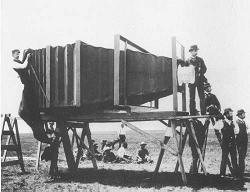
Katy has been listening to a fantastic multimedia photo-history podcast from an uncommonly devoted community college professor. One of the last mentioned what was and probably will remain the largest conventional negative camera ever made, used by George Lawrence to make a 4 1/2 x 8 foot glass plate negative of a locomotive for the upcoming Paris Exposition (Lawrence is most famous for using kites to lift cameras to 2000 feet for arial panoramas, such as those of San Francisco immediately following the Great Fire). Here it is in all of its 1400 lb glory, with about half of the team necessary to operate the beast:


and


Further research
revealed the existence of the Moby C at 2nd and Bleeker in NYC, the largest polaroid camera in existence, capable of 40" by 106" prints. It was originally used to make life-size reproductions of paintings, but the scale is also, incidentally, ideal for life-size polaroids of humans as well. There is something about capturing 1:1 images that makes photographs break the bond of representation and recapture some of Walter Benjamin's destroyed "aura". It turns the camera into some kind of frozen mirror, a human-capturing device.

But no discussion of gargantuan cameras would be complete without a mention of the (very recent) Legacy Photo Project, which captured a 25' x 100' cloth negative using an abandoned aircraft hangar as a gigantic camera obscura:


So here you have it, the world's first Borges Mapping Engine. Or perhaps a new weapon, the landscape soul thievery device! Able to steal the special aura surrounding any vista, hillock or monument you can think of, for transport and re-display at will. Ancient town centers and natural wonders beware! Your charms are no longer safe!

Wednesday, September 19, 2007

fun with color

When I was in school the only real lessons we got in color theory were "there are no bad color combinations," and then a big "have at it!"

This doesn't even begin to touch on the ways that colors interact. Ever wonder why there is a light purple but no dark yellow? Ever wonder what the real difference between whiteness and brightness is? Well trip on down to LivelyGrey, play some games, and learn some lessons. You'll be glad you did.

Monday, September 17, 2007

"tremendous symbiosis of Progress and Nature"

This is what archibase calls the Stockholm Metro. I would have to agree:


"The Stockholm Metro, or Stockholms tunnelbana, is the metro system in Stockholm, Sweden. The system has three main lines and one hundred stations, 47 of which are subterranean and 53 are aboveground (surface and elevated) stations."


"Stockholm's metro is well known for its decoration of the stations; it has been called the longest art exhibit in the world. Several of the stations (especially on the Blue line) are left with the bedrock exposed, crude and unfinished, or as part of the decorations."


Tremendous, indeed. I have never, in my years of mass transit, seen anything approximating this. Say what you will about the scale of D.C.'s tunnels and the baroque chandeliers of Moscow. I'll take the caves of Stockholm, thank you very much. Why on earth have the Swedes not let everyone know about this? Those cheeky Swedes.


(Thanks to things magazine for the heads up)

Sunday, September 16, 2007

waste=food=bs

Mr. Manaugh of BLDGBLOG posted a few days ago on a joint performance by Michael McDonough and Michelle Kaufmann at this weekend's Dwell on Design conference. The "big idea" of this presentation was apparently that "conductive" materials, such as metal, should be avoided in new housing in favor of "insulative" materials. I might be slightly biased in all of this, but this seems like a crazily reductive and somewhat specious argument to be making in front of thousands of paying customers. Not only is McDonaugh simplifying the idea of sustainability to a single variable (energy performance), but he seems to be ignoring holistic strategies and even the existence of more than one climate on this earth! In addition, heat conductance is a relative value, and roof, wall, and floor construction is almost always, by necessity, an assembly, so where do you draw the line, and with which material?

My other beef seems to be that Ms. Kaufmann is supporting this argument to differentiate her (wood framed) modular construction from similar (steel framed) modular construction, on the basis of sustainability. Never mind that the first Leed Platinum home in the country is entirely steel framed.

I think that Mr. McDonaugh and Ms Kaufmann are both very intelligent, gifted architects that have contributed greatly to the idea of a sustainable, well designed environment. And I'm definitely not going to claim that recycled steel is a perfect building technology. But this presentation seems to me to be a warning shot-- the first in a series of "sustainability wars" where hype and proprietary technologies overcome the need for shared information and measured individual solutions. If we've learned anything from previous modern mistakes, it's that a single and homogeneous treatment of any problem is going to be seriously lacking in resilience and vitality. So I am making an open request to Michele and Michael-- next time you use your considerable clout to fight for sustainability, please try to acknowledge the need for a comprehensive, heterogeneous, multivalent solution to the problem. Simply saying "metal is bad" does no one any good.

Sunday, September 09, 2007

weak ties and strong language

The new Key Magazine in the NYT has this article of interest, a combination anthropological study of SoCal condo life and general expose on the marketing of "lifestyle" urban living centers. The jury's still out on whether the findings are reassuring or frightening. The (somewhat geriatric) gist is that the young folks don't want to leave their college dorms, which reminds me of this BLDGBLOG post that posits that our wish for pedestrian urbanism is, for most, really a nostalgia for campus life.

One problem I do have with the article is that it casts contemporary social networking as a kind of mass solipsism-- all of the examples cited are chiefly recreational groups. No mention is really made of groups that produce-- other than a sideways mention of Burning Man, which is somewhat equated in the article with flash mobs. Actually, come to think of it, the while article is sprinkled with condescension of this type, which seems to spring from the unspoken assumption that a mortgage and family is the de facto "normal" way of life in our country. So maybe I don't like this article after all. But I like the slide show. Look at that.

Tuesday, September 04, 2007

gentlemen, there is no fighting in the war room

I promise I'll start posting more regularly, but for the time being here's some filler. Slate.com has this lovely, detailed article on the true state of international nuclear relations. The gist is that the cold war has not ended, it's just on hiatus. But there are also some great bits on an impervious quartz mountain-cave bunker headquarters.

Sunday, August 26, 2007

monstrocity! cementland!

If the above words make your heart accelerate, you might want to check out the recent NYT article on Bob Cassilly, and his two past and one future creations: The City Museum, MonstroCity, and CementLand. All are junkyard conglomerations built upon former industrial sites for the purpose of, in Cassilly's words, providing a place “where people can come and do things they’re not supposed to.” I have harped on this again, again, and again. Post-industrial lots are the beginnings of great public spaces. I heard just yesterday a person from Friends of the LA River talk about the reclamation of 20 acres of former rail yard next to the river into a combination of wetlands and community soccer fields. In order to do this they had to first sue the county and city to keep it from being zoned for further industrial use. These things do not happen on their own. What is your local Highline?

Wednesday, August 22, 2007

technopeat

Once again I have been lazy. I have no excuse.

There is a good article by Beth Daily at the Boston Globe about how there is an enormous market for secondhand industrial and transportation technologies in second- and third-world countries. When a city replaces its bus fleet, or a factory goes out of business and its power plant is dismantled, the detrious is recycled in a very literal way-- it is shipped and reassembled in Guatamala, or Kenya, or Sri Lanka. It is a large scale version of what Bruce Sterling calls "the new composting the old," with "outdated" technologies not disappearing but merely retreating out of the view of those of us who remain slavishly up-to-date, becoming cheaper and more receptive to hacking or modifying.

The article takes the slant of sustainability, and does a good job of conveying the complexity of the issue-- reuse is good, but often repurposed items (such as diesel buses) are replaced because they are polluting or inefficient-- the idea being that, when that coal power plant next door shuts down, it actually will spew carbon for another 50 years or so, only in South America.

I'm tempted to step aside all of this calculation and simply be satisfied that things are being used to their fullest extent; that the world is becoming more complex and interconnected, at a very basic and ground up level, every day. I can only wait for the day when we start using secondhand robots from Nicaragua, or retitled Balinese spacecraft. The world of the secondhand is mostly immune from the world of branding and global identitiy -- what is getting sold is the possibility for energy, or conveyance, or communication. And an intangible alien quality that never quite diminishes with age.

Thursday, August 16, 2007

infrastructure urbanism redux

"...infrastructure should be defined not by what it looks like, and not by who designs it or who pays for it, and not by who builds it or actually uses it. It should be defined by whom it is meant to serve. For all its seemingly disparate parts, infrastructure comprises those elements in a metropolitan region's physical landscape that are meant to serve the public--or rather, the sometimes competing, sometimes overlapping, and sometimes wholly discontinuous publics that populate today's American metropolitan areas and are critical to the growth of our country."


Yes, yes and yes. This New Republic Article (subscription required to get beyond the first page) makes most of the talking points for the post-Minneapolis "rotting infrastructure" harangue, but with enough erudition and restrained anger to be convincing, even inspiring. Good job, Sarah Williams Goldhagen. Even the comments afterwards (mostly) continue the argument in a sane and rational manner. I'm going to start my own harangue here, but Goldhagen is obliquely making the same point I've been trying to drive home-- that infrastructure in now the primary mode of public space and spending, and that it's resources as an urban collector are poorly exploited (if at all). What this article points out is that we have underbuilt and undermaintained consistently over the last few decades, while veritably pouring money into private-public developments like arenas and "town centers," developments that would probably have come to bear with our without government support.

Who will speak for the aqueducts, for the aqueducts have no lips? Um, me.

Wednesday, August 15, 2007

flaying the beach

I'm easily embarrassed. I'm not only embarrassed when I say the wrong thing or feel conspicuous, but can cringe just as easily at the shaming, real or imagined, of other people, even complete strangers. So it has taken me a while to get used to Katy lugging around a camera approximately the size of our dog wherever we go. This becomes particularly troublesome (to me only, as Katy is much more well-adjusted about this sort of thing) when we are near the beach, such as the local land of the lotus eaters. Once, on the Santa Monica Promenade, as Katy was photographing some neon, a woman looked at us, shook her head, and said, "more idiots."

This kind of response is actually not what I am afraid of. What embarrasses me the most is the idea that we're being taken for tourists casually and without comment. There is a kind of basic condescension towards visitors that makes me automatically indignant when I feel we don't fit in. There's a great passage in V., which I'm too lazy to look up now, where Pynchon talks about how tourists are only interested in the surface of a place, seeking to get a quick feel for the locale and then on to the next topographical experience. I suppose most of my embarrassment comes from an assumption that other people are assuming that I don't care about where I am that much. Yes, I realize this is very, very silly.

The thing is, I shouldn't be ashamed of my status as a visiting outsider. I should be proud. I can't count the number of times I've tried to look at a familiar landscape with new eyes; every time I visit my parents I try to force my eyes into an alien configuration so I can see my old neighborhood as a stranger would. So what I am bringing to, say, Manhattan Beach is a heroic perspective, a fresh outlook, beautiful misunderstandings and a ludicrous fascination with even the most mundane details. I, unlike a local, am taking nothing for granted. And my wife is recording this heroic exploration in great detail, to forever mark this place and time as ours. I should be planting a flag. A small flag with my name and address, asking people to please, walk down my street, write down what they see, and send it to me. It's the least they can do in return.

Monday, August 13, 2007

gsdelicious

In retrospect, the post-Miesian tower, the mono-functional rectilinear vertical extrusion clad in dark or mirrored glass (which proliferated around the world in the second International Style era of the ’60s onwards) marks architecture’s all-time nadir, even if some examples were well detailed and proportioned.


This culled from a new article by Peter Buchanan in Harvard design magazine. The article is a lot less polemic than that quote may suggest, but I appreciate the bold thinking involved; indeed, but the rubric that Buchanan sets forth (basically, LEED standards and standard urbanism), this may be true. Buchanan isn't some kind of architectural Luddite; the rest of the article is basically a mash note for the Swiss Re tower. I do like the historical viewpoint that he takes about the current state of iconic international competitions:

All these seem last-fling sunset effects from a waning era when, beside the defects listed, towers helped create dismal cities and aptly symbolized their extreme economic and social inequalities.


Makes me feel like I'm living in Blade Runner. But who would have guessed even ten or fifteen years ago that there would be this sudden explosion of modern pyramids? In the last thirty years of science fiction we went from white iconic idyll (2001) to dystopian megamachine (Blade Runner, Alien) to a banal sprawl where all of the action is virtual (Gibson, Stephenson). I honestly think that the concentration of power and weath will always have dramatic physical expression, even if all of the action is taking place electronically. Sorry, Neal, you might be wrong this time.

Sunday, August 12, 2007

i pity the fool

My good friend Mr. T left a comment on my last post that made me realize that the brevity of my comments may have been misleading. The full text of T's comments are below, with some interjections by myself:

A critical and possibly obvious distinction between branded building materials or components and branded complete environments or buildings is that components, no matter how innovative, will consistently be arranged and assembled according to old notions of space and comfort. Maybe this is the most reasonable and careful route to the “future.” It is certainly the most fluid and it’s not as though one could realistically argue for its end.

However, to submit completely to this kind of slow progress would, in fact, be a real break from history. It would also signal the validation of Tafuri’s grimmest assessment of the architect’s position in a capitalist society. The design of pre-fabricated homes as a supplement to the market’s new components has the potential to expand our ideas of home and even community at a broader scale than a new glazing system or refrigerator ever will. Without a comprehensive reexamination of pre-manufactured space, the use of new materials will effectively amount to “pimp my house.”


While I'm always a bit leery of applying Tafuri to contemporary problems in architecture, I completely agree with this. To flesh out my argument a bit further, I foresee the "pimp my house" situation as a status quo to rise above; domestic spaces are now being commodified in ways more complex than the simple application of "style". These hybrids of furniture, decoration and architecture must be exploited by architects if we are to maintain any agency in popular residential architecture.

While new products represent technological advances, new product-houses represent the synthesis of this technological growth along with cultural shifts. No, the pre-manufactured home is not new, but its continued development cannot be seen as the mere prolongation of a fad or trend. It has become established as a component of our built environment and, therefore, deserves further investigations.


This is as elegant and concise a way of presenting my current attentions as I can think of. Mr T., this is my new thesis statement.

Furthermore, while the market does innovate, it will only ever innovate in ways that sustain the market. For this to be a critique with any merit, the architect must, of course, have real aspirations beyond the market. So with this important condition in place, an architect can offer new ways of constructing that move beyond what the consumer will have otherwise. This is not a denial of the aegis of the consumer over the built environment, but it serves to reaffirm and validate the accumulated knowledge and trained effort of the architect as designer.

Rybczynski's main point seems to be that today’s pre-fab homes are just too expensive. This may be true, but as with any modern product innovation, costs decrease with increased production and market driven competition. Today’s consumer also sets a higher hurdle for the design of his home. As income gaps grow and the cult of the wealthy is fueled by widespread media reassurance, the poorest American has higher or more pointed expectations of comfort. In a hyper-commercialized society such as ours we must recognize that change requires effort.


Italics are mine above. That is a very good point about the dangers of free market determinism, and was the main reason I felt the need to address T's comments here. Architecture has many values beyond monetary value or status or anything related to commodity; the primary reason for the existence of architecture probably lies beyond the realm of calculable value, a fact is consistently overlooked. However, for architecture to regain any agency in residential and popular design, value- and product-driven concepts must be reintroduced into the architectural vocabulary. It is this synthesis that I am struggling to understand and project into the future.