Saturday, February 20, 2010
movin' on
If you're looking at this page you're at the wrong place! My lovely wife has started the process of self-hosting all of our various family blogs. You can find my newest stuff at work.permanentriot.com. Hopefully the new site will inspire me to be more diligent about posting. And if not, at least it can be pretty in lieu of informative or interesting.

Thursday, December 31, 2009
notes on digital reading
my lovely wife got me a kindle 2 for the holidays, and I thought that I might do what nearly every person who has purchased the thing has done and write about it on my blog (writing on the internet seems to be the primary hobby of kindle owners).
After a few days of using the thing, what really surprises me the most is how different it is from any other digital device. It's really impossible to do any kind of real comparison between an e-reader and an iphone or laptop or netbook or OLPC. For one, the Kindle is (as of yet) pretty much useless as a web device, due to the constraints of the software, connection, processor, and screen (in that order). it's not impossible that it might be usable to email or search with some OS improvements, but the lag in typing and the difficulty in browsing means that, at best, it is useful for reading a few mobile news sites and wikipedia (it actually works quite well as a wikibrowser.)
What is does do extremely well is show text on a screen. I'm going to go ahead and say right now that I prefer reading on the kindle to reading a paperback. I've never been a fan of portable books - I always struggle with hand cramps and sore necks. This object is the right size, weight, and look for reading. I actually went back to a book last night and was kind of annoyed. It's also fun to operate, has a good feel and good "cover" images (although the ability to customize would be nice).
The end result of all of this is that this might be the first digital device I've met that will actually end up slowing and concentrating my life rather than speeding and scattering. It's fun to use so I'll probably spend more time as a result reading novels, long-form magazine articles. Multi-tabbed browsing, skipping to minute 3 of a youtube video, quickfire rss feeding - this all now seems a little less important, and a little less fun.
It's interesting that by changing the priorities and limitations of a device, one's life can be subtly changed.
After a few days of using the thing, what really surprises me the most is how different it is from any other digital device. It's really impossible to do any kind of real comparison between an e-reader and an iphone or laptop or netbook or OLPC. For one, the Kindle is (as of yet) pretty much useless as a web device, due to the constraints of the software, connection, processor, and screen (in that order). it's not impossible that it might be usable to email or search with some OS improvements, but the lag in typing and the difficulty in browsing means that, at best, it is useful for reading a few mobile news sites and wikipedia (it actually works quite well as a wikibrowser.)
What is does do extremely well is show text on a screen. I'm going to go ahead and say right now that I prefer reading on the kindle to reading a paperback. I've never been a fan of portable books - I always struggle with hand cramps and sore necks. This object is the right size, weight, and look for reading. I actually went back to a book last night and was kind of annoyed. It's also fun to operate, has a good feel and good "cover" images (although the ability to customize would be nice).
The end result of all of this is that this might be the first digital device I've met that will actually end up slowing and concentrating my life rather than speeding and scattering. It's fun to use so I'll probably spend more time as a result reading novels, long-form magazine articles. Multi-tabbed browsing, skipping to minute 3 of a youtube video, quickfire rss feeding - this all now seems a little less important, and a little less fun.
It's interesting that by changing the priorities and limitations of a device, one's life can be subtly changed.
Tuesday, December 01, 2009
Saturday, July 25, 2009
scattermoonshot
I'm a bit late at this, but there's been a lot of bemoaning lately (or is it just moaning?) about the 40th anniversary of the moon landing. From Wired to Tom Wolfe, there has been a lot of furious agreement with astronauts and rocket scientists, that we really dropped the ball these last...four... decades. We should all be living on Mars by now, like Ben Bova wants us to! Like any proper nerd, I occasionally consider what it might be like to bring someone from the past - say, Benjamin Franklin - and introduce them to modern society. It gives one the ability to be amazing without actually doing anything, by piggybacking on two hundred and fifty years of technical and social progress. One gets to be the salesman that reveals your... new... future!
However, if instead of a founding father it's, oh, Arthur C. Clarke, circa 1968, things get a little bit iffy. Then one has to explain how a colossal, colossal increase in computing and communications ability has made only subtle changes to our social fabric. How is it that telegrams and rockets can be so destabilizing to the status quo, produce a few World Wars and a subsequent world order on the other side, while similar technologies that are unbelievable improvements on connecting and computing lead to people working harder and a few stock market bubbles? Oh, and twitter.
Hulu is a great example. Why is Hulu so amazing? It roughly replicates cable TV, with slightly more interactivity, on a device that could land the population of Canada on the moon in LEMs, simultaneously. This is not an amazing use of your computer. It's like getting Pavarotti to sing the Oscar Meyer Weiner song. What is amazing about Hulu is the business side - getting networks to agree to put their content online, the social side - selling it to the public, and the design side - the interface and video algorithms. And none of that is colossal.
However, if instead of a founding father it's, oh, Arthur C. Clarke, circa 1968, things get a little bit iffy. Then one has to explain how a colossal, colossal increase in computing and communications ability has made only subtle changes to our social fabric. How is it that telegrams and rockets can be so destabilizing to the status quo, produce a few World Wars and a subsequent world order on the other side, while similar technologies that are unbelievable improvements on connecting and computing lead to people working harder and a few stock market bubbles? Oh, and twitter.
Hulu is a great example. Why is Hulu so amazing? It roughly replicates cable TV, with slightly more interactivity, on a device that could land the population of Canada on the moon in LEMs, simultaneously. This is not an amazing use of your computer. It's like getting Pavarotti to sing the Oscar Meyer Weiner song. What is amazing about Hulu is the business side - getting networks to agree to put their content online, the social side - selling it to the public, and the design side - the interface and video algorithms. And none of that is colossal.
Wednesday, July 01, 2009
honored
Wow, MRP made things magazine. Way more exciting than the fast company blog.
Speaking of honored, I found out from Tyler that my final project at Rice made it into Everything Must Move. I should get me a copy.
Speaking of honored, I found out from Tyler that my final project at Rice made it into Everything Must Move. I should get me a copy.
Saturday, June 13, 2009
two links and a sigh, then some promise
It's been a rough month for modern prefab. MKD is down, and shockingly Empyrean closed their doors as well. Both of these companies made a great product and it's kind of a shock (especially Empyrean, they were one of the first and biggest prefabricators, and broke a lot of new ground over the years).
Christopher Hawthorne over at the LA Times wrote this great article that should be required reading for anyone asking questions about the future of this industry. Sober, incisive, and maybe just a little pessimistic.
I also came across this modular marketing blog this morning. I expected it to be all bluster and invective, but instead I found a very down-to-earth, helpful, and frequently insightful boots-on-the-ground report. For anyone who thinks that prefabrication is dead, look at this site-- it might not be in Dwell for a while, but there are plenty of people doing good work.
This site also turned me onto the fact that Clayton Homes is entering the sustainable modern market. How on earth did I miss that? It's a solidly MOR approach, as should be expected for any company that actually wants to make money with their product, but I found a lot to like about the i-house (despite a terrible, terrible name). I was actually brought up short by what these guys came up with. It now seems to me that perhaps the real lasting effect of the last 10 years of modern prefab experimentation was to alert the giants of the industry that this niche market was important and growing. Clayton expects this line to bring in 10% of their revenue!
Granted, it's no Muji home (dear god I am jealous of those Japanese), and Clayton doesn't have quite the populist modern cache of Ikea, but I think the i-house might be a bellweather for the future of this industry.
Christopher Hawthorne over at the LA Times wrote this great article that should be required reading for anyone asking questions about the future of this industry. Sober, incisive, and maybe just a little pessimistic.
I also came across this modular marketing blog this morning. I expected it to be all bluster and invective, but instead I found a very down-to-earth, helpful, and frequently insightful boots-on-the-ground report. For anyone who thinks that prefabrication is dead, look at this site-- it might not be in Dwell for a while, but there are plenty of people doing good work.
This site also turned me onto the fact that Clayton Homes is entering the sustainable modern market. How on earth did I miss that? It's a solidly MOR approach, as should be expected for any company that actually wants to make money with their product, but I found a lot to like about the i-house (despite a terrible, terrible name). I was actually brought up short by what these guys came up with. It now seems to me that perhaps the real lasting effect of the last 10 years of modern prefab experimentation was to alert the giants of the industry that this niche market was important and growing. Clayton expects this line to bring in 10% of their revenue!
Granted, it's no Muji home (dear god I am jealous of those Japanese), and Clayton doesn't have quite the populist modern cache of Ikea, but I think the i-house might be a bellweather for the future of this industry.
Thursday, May 07, 2009
I've been a bad blog daddy
So my last post was September 16. Coincidentally, Katy went into labor that week and somehow I never got around to regular blogging again. Well, it's time to come back. The first five months or so I had a pretty good excuse. But since then Amalgamated Baby & Baby has been going to bed at seven and sleeping through the night, and I have no infants left to take the blame. I'm going to fight back against the evils of RSS feeds and online Netflix, and attempt to reintroduce myself in some way back into adult society, even if through a digital proxy.
Here's the first chestnut I have to lob into space (warning, bore alert):
How much longer until systems engineering becomes a necessary part of multinational architecture? If the last decade of architecture has made much headway (and I have my doubts) it's in attempting to rationalize and codify the value of design. What is baffling to me is that this has been done more successfully by people designing cars and cellphones. Architects seem to have been stuck re-hashing the same arguments, with slightly varying terminology, for roughly the last eighty years. Or at least the last twenty five.
It strikes me as plausible that, when discussing the success of Apple versus the relative obscurity of Norman Foster, the real difference is not in commodity value but rather in systems engineering. The entire idea of coordinating complex material and labor flows, attempting to rationalize a design with a material reality, from the very beginning, is something that architecture hasn't necessarily caught on to. Architects inevitably get stuck on meta-discussions about cultural relevance, and relegate the space-time stuff someone else's lap, in the last half of the schedule.
Obviously the problem here is dollars, or yuan, and how and when they're getting given around to people. "We don't have time," we always say, "and our margins are too thin as it is." Our margins are too thin because most clients consider our work to be at least 50% window dressing. And these considerations are the result of architecture having a poorly explained value, beyond a roof that doesn't leak and marginal improvements in worker productivity. BMW doesn't have to explain the value of design to anyone. And, despite what you're thinking right now, it's not because people love cars. It's because BMW has people who love to think, talk, and live automobile design, who talk to other people at bars about things that are not related to automobiles, and then come back and breathe this life into their cars, AND that these designers have an unseverable direct link to a system of engineering and production that is simultaneous and nearly instantaneous. Oh, and Everyone. Is. On. The. Same. Team.
Boy, that would be nice.
Here's the first chestnut I have to lob into space (warning, bore alert):
How much longer until systems engineering becomes a necessary part of multinational architecture? If the last decade of architecture has made much headway (and I have my doubts) it's in attempting to rationalize and codify the value of design. What is baffling to me is that this has been done more successfully by people designing cars and cellphones. Architects seem to have been stuck re-hashing the same arguments, with slightly varying terminology, for roughly the last eighty years. Or at least the last twenty five.
It strikes me as plausible that, when discussing the success of Apple versus the relative obscurity of Norman Foster, the real difference is not in commodity value but rather in systems engineering. The entire idea of coordinating complex material and labor flows, attempting to rationalize a design with a material reality, from the very beginning, is something that architecture hasn't necessarily caught on to. Architects inevitably get stuck on meta-discussions about cultural relevance, and relegate the space-time stuff someone else's lap, in the last half of the schedule.
Obviously the problem here is dollars, or yuan, and how and when they're getting given around to people. "We don't have time," we always say, "and our margins are too thin as it is." Our margins are too thin because most clients consider our work to be at least 50% window dressing. And these considerations are the result of architecture having a poorly explained value, beyond a roof that doesn't leak and marginal improvements in worker productivity. BMW doesn't have to explain the value of design to anyone. And, despite what you're thinking right now, it's not because people love cars. It's because BMW has people who love to think, talk, and live automobile design, who talk to other people at bars about things that are not related to automobiles, and then come back and breathe this life into their cars, AND that these designers have an unseverable direct link to a system of engineering and production that is simultaneous and nearly instantaneous. Oh, and Everyone. Is. On. The. Same. Team.
Boy, that would be nice.
Tuesday, September 16, 2008
youth groups.
One of the more surreal experiences I had in high school was a ski trip with a friend's youth group in Colorado. After a day on the slopes I was treated to a whiplash of, say, a lecture on the evils of macroevolution followed by getting drunk in a hot tub with my fellow brainwashees. There were also harrowing "study groups" that consisted of groups of a half dozen boys (or girls, although they were on another floor altogether), with a single, stone-faced parent, who would quietly and forcefully induce a strange combination of conversation and indoctrination, a process that strangely could be easily be derailed by asking a few questions or changing the subject. It was clear by the second day that the crew-cut head of our group didn't enjoy his role any more than we were enjoying ours. The whole escapade climaxed on the third day, when he broke down crying, saying "I've made some mistakes in my life that I don't want you boys to have to experience." This was the only part of the long weekend that I couldn't roll my eyes at, although I did have a little bit of fun trying to figure out exactly what this transgression might have been. I came away from the whole thing horrified at my taste of evangelism but convinced that it wasn't nearly as dangerous, insane, or effective as alarmists might make it out to be.
I say this not to establish my fundy cred, but rather as a long introduction to this solitary point: what that poor dad was trying to do in Breckenridge is the diametric opposite of the aim of an average pop musician. His frantic sheltering was being actively countered by the frantic exposure in every song we listened to, endlessly flaying us with heartbreak and regret. What is interesting is that this man clearly experienced something analogous to what you get from your Wonder or your Cobain; these musicians are not only pantomiming heartbreak for the adolescent; they are also fixing and remembering it for the old.
I say this not to establish my fundy cred, but rather as a long introduction to this solitary point: what that poor dad was trying to do in Breckenridge is the diametric opposite of the aim of an average pop musician. His frantic sheltering was being actively countered by the frantic exposure in every song we listened to, endlessly flaying us with heartbreak and regret. What is interesting is that this man clearly experienced something analogous to what you get from your Wonder or your Cobain; these musicians are not only pantomiming heartbreak for the adolescent; they are also fixing and remembering it for the old.
Thursday, July 24, 2008
Steampunk and Tiny Motorbikes
Randy Nakamura had a brief freakout yesterday. Topic? Steampunk.
This ending is a bit hyberbolic compared to the rest of the essay, which, as the sole intelligent commenter pointed out, wasn't really a condemnation of the movement as a whole but rather a purely aesthetic dismissal of steampunk as a generator of new or beautiful form. Thus most of the offended people missed Randy with their comments as much as he missed them in his post; steampunk is perhaps a wonderful community / craft movement / source of innovation / party theme, but it has few chances at being incorporated into the larger world of design largely because the vast majority of design objects are rehash of a previous style (Victorian) that is itself an eclectic recombination of even older design.
What Randy ignores are the potentials latent in the current culture of design that are what is making steampunk such a popular (and yes, hypeable) movement. The complaints about contemporary industrial design bandied about by people coming out of this movement -- the predominance of the lightweight and short-life materials, the lack of handicraft, minimalism as an end not a means-- are all quite valid. Designers from every corner are currently attempting to add heft and decorative power to their work, from graphics to products to architecture. This is a nerdy, charmingly DIY attempt to reach a homemade analogue. And while I could personally do without the retrograde (even reactionary) Hot-Topic Victorian throwbacks, I can appreciate steampunk's healthy humor and reappropriative behavior.
In fact, what this really reminds me of is the work of Adrian van Anz, the progenitor of one-off platinum iPods and desktops. Here you have handicraft, longevity, and cultural reference, and it doesn't remind me of Myst at all. Here's a one to one comparison:
Steampunk motorcycle:

Cheap but Ugly.
van Anz equvalent:

Derringer Cycles: Pretty but overpriced.
So while I probably agree with Randy that steampunk won't have any lasting effect upon the world of general design beyond movies and a few video games, it is an important signifier of the yearnings and obsessions in the design-conscious public. People are waking up from their blind love for all things shiny-- we want our stuff to last, we want it to wear, and we want it to hurt when it falls on our foot.
We are being taken for rubes. At worst, the Steampunkers seem to be mediocre hobbyists with great publicists. It seems fine to me that an obscure niche of DIY hobbyists want to create an imaginary Victorian present, no matter how insular or simpleminded it might be. Reality is what you make of it, even if it is apparent that some people prefer reality to look like a discarded sci-fi movie prop. It is entirely another thing for the press, in their endless “style” trolling, to claim Steampunk as some sort of important movement. If the press behaves as a gaggle of inept tastemakers, then the uncritical pimping of Steampunk must serve as a “mission accomplished.” What it boils down to is that instead of inventing something new, the Steampunkers have mastered one of the oldest of arts: that of self-promotion. P.T. Barnum, that 19th century master of theater, hoax and hype, would be proud.
This ending is a bit hyberbolic compared to the rest of the essay, which, as the sole intelligent commenter pointed out, wasn't really a condemnation of the movement as a whole but rather a purely aesthetic dismissal of steampunk as a generator of new or beautiful form. Thus most of the offended people missed Randy with their comments as much as he missed them in his post; steampunk is perhaps a wonderful community / craft movement / source of innovation / party theme, but it has few chances at being incorporated into the larger world of design largely because the vast majority of design objects are rehash of a previous style (Victorian) that is itself an eclectic recombination of even older design.
What Randy ignores are the potentials latent in the current culture of design that are what is making steampunk such a popular (and yes, hypeable) movement. The complaints about contemporary industrial design bandied about by people coming out of this movement -- the predominance of the lightweight and short-life materials, the lack of handicraft, minimalism as an end not a means-- are all quite valid. Designers from every corner are currently attempting to add heft and decorative power to their work, from graphics to products to architecture. This is a nerdy, charmingly DIY attempt to reach a homemade analogue. And while I could personally do without the retrograde (even reactionary) Hot-Topic Victorian throwbacks, I can appreciate steampunk's healthy humor and reappropriative behavior.
In fact, what this really reminds me of is the work of Adrian van Anz, the progenitor of one-off platinum iPods and desktops. Here you have handicraft, longevity, and cultural reference, and it doesn't remind me of Myst at all. Here's a one to one comparison:
Steampunk motorcycle:
Cheap but Ugly.
van Anz equvalent:
Derringer Cycles: Pretty but overpriced.
So while I probably agree with Randy that steampunk won't have any lasting effect upon the world of general design beyond movies and a few video games, it is an important signifier of the yearnings and obsessions in the design-conscious public. People are waking up from their blind love for all things shiny-- we want our stuff to last, we want it to wear, and we want it to hurt when it falls on our foot.
Tuesday, July 01, 2008
Tuesday, June 24, 2008
For Your Consideration: Sanikiluaq, Nunavut
Yes, that's right. Sanikiluaq. Nunavut. Wikipedia claims this fantastic title belongs to "a small Inuit hamlet located in Hudson Bay, on the Belcher Islands, in the Qikiqtaaluk Region of Nunavut, Canada."
That's right. Inuit. Hamlet. The words just keep piling on. Qikiqtaaluk.
It even looks like another planet:
View Larger Map
For those of you that think that we Americans own the frontier, think again. There is no location in the continental U.S. that looks as desolate and remote as this place in the center of Canada:

The entire Wiki entry for the Belcher Islands themselves concerns a)Geology and b)Multiple religious Eskimo murder in the 1940's.
Sanikiluaq. Nunavut.
That's right. Inuit. Hamlet. The words just keep piling on. Qikiqtaaluk.
It even looks like another planet:
View Larger Map
For those of you that think that we Americans own the frontier, think again. There is no location in the continental U.S. that looks as desolate and remote as this place in the center of Canada:
The entire Wiki entry for the Belcher Islands themselves concerns a)Geology and b)Multiple religious Eskimo murder in the 1940's.
Sanikiluaq. Nunavut.
Wednesday, June 04, 2008
palms=set!
For those of you that wonder what I do, here's a great chance for me to make it seem like things are much more exciting than they really are. We've had a frenzied week at the office, as a house was delivered and set on Tuesday and today. What is so special about this time is that it happened less than a mile from my house! Oh so exciting. The Palms residence is 14 mods, 2800 interior sf with 700 sf of deck space, on a typical Venice lot, around 40'x120' with a back alley. It's a two story house with some nice use of negative space (entry courtyard, stair atrium with skylight). It's also a reasonably green home(we weren't able to get it certified due to paperwork/inspection issues but we're pretty sure it would have rated silver). It was set over the last two days but in reality the craning only took about 5 hours total! The neighbors all came out to watch and it made a merry little scene. Tons of dogs and kids, and a guy in his bathrobe that looked pretty damn confused. It made me want to move to Venice-- I've never seen people this non-NIMBYish about modern houses. It's gotten some (friendly) coverage on Curbed, and the KTLA morning news came out and gave it the better part of an hour. That's right, MRP was on the CW. Holla. There was also a film crew and even some helicopters getting aerial shots(!?!) No, it's not usually this way.
Katy was also hired by the office to get some action shots-I posted a few of them below. Some of the factory guys seemed a little nervous to see a pregnant lady in a hard hat running around a construction site. Go fig. But at least she got awesome pictures-- there are more than 500 total but she's got a smaller selection on her Picasa site.
 350 tons of craney goodness.
 The guys at the factory made some stencils on the CNC mill and went to town on the shrinkwrap.
 Oh yeah.
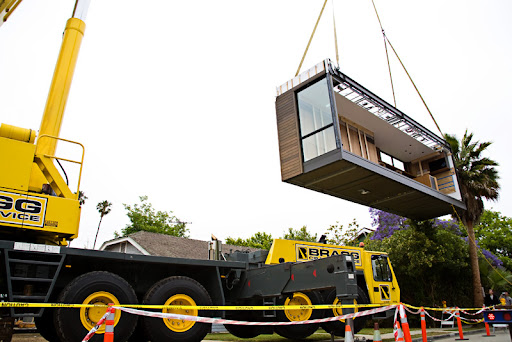 That's the kitchen, 25 feet in the air.
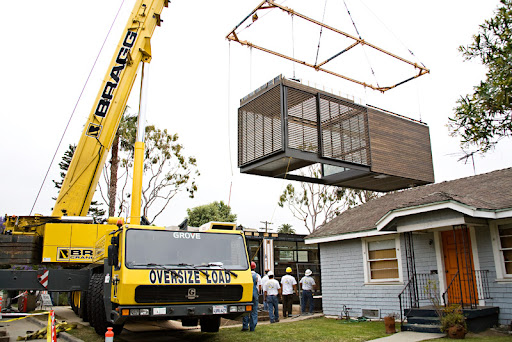 Every mod had to be lifted over the house next door. The owner was joking that he was praying for some free demo.
 Work it, Mike.
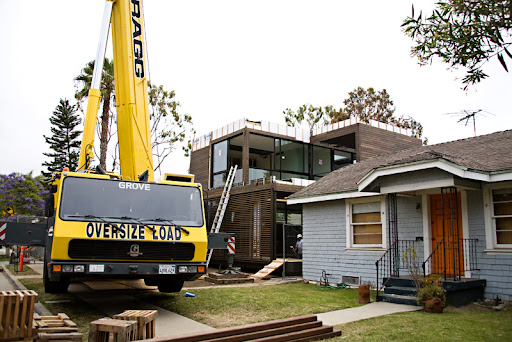 10 am this morning: complete!
 Still a lot of work to do... notice how nicely that siding lines up.
 Entry court.
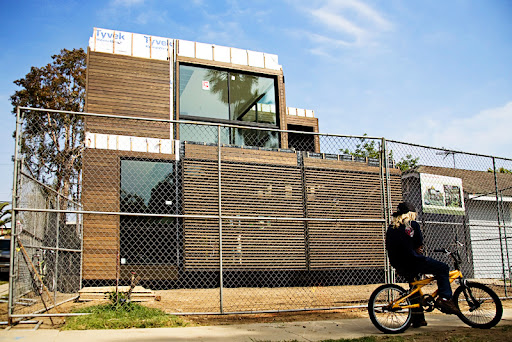 And then there was house.

Next up: the Dwell conference this weekend! I'll keep you posted. Things are crazy around here.
Katy was also hired by the office to get some action shots-I posted a few of them below. Some of the factory guys seemed a little nervous to see a pregnant lady in a hard hat running around a construction site. Go fig. But at least she got awesome pictures-- there are more than 500 total but she's got a smaller selection on her Picasa site.
350 tons of craney goodness.The guys at the factory made some stencils on the CNC mill and went to town on the shrinkwrap.Oh yeah.That's the kitchen, 25 feet in the air.Every mod had to be lifted over the house next door. The owner was joking that he was praying for some free demo.Work it, Mike.10 am this morning: complete!Still a lot of work to do... notice how nicely that siding lines up.Entry court.And then there was house.Next up: the Dwell conference this weekend! I'll keep you posted. Things are crazy around here.
Sunday, June 01, 2008
why not architecture, fashion, taste?
Just spent a half hour exploring Fantastic Journal, which I hadn't realized was written by one of the minds behind FAT until the very end. For a great post check out this bit dissecting the "Ladybird Story of Houses," a 1960's era children's book that does a wonderfully subtle job of reshaping children into secret modernists. Not to offend you, Mr. Holland, but might not the first wave of postmodernism in the 80's be nothing more than rebellion against childhood indoctrination? In any case, this blog is another brick in the wall of argument that, despite one's taste in architectural production, it is undeniably true that the more references you find on or in a building, the better the architect must be able to write. As you can tell from this blog, I must work at an architecture firm that used to make everyone type "neutra" daily to log on to their computers.
Friday, May 23, 2008
on tactile memory
Bending over to open a cabinet and retrieve dinner for my dog, I noticed the handle to the cabinet door. It's a nasty bit of overdetailed poorly cast pot metal that is so blurry and undefined that at times I wonder if they're really there, or just memories of real hardware in some other, more commodious kitchen. They are also just a little bit sticky, but this might just be from Herbie trying to lick his way through the cabinet door.
I grab onto these handles at least twice a day. I remember the feel of them in my hand (lumpy and uncomfortable) and could probably sketch a fair reproduction of one right now if pressed to do it. And yet I cannot for the life of me remember their counterpoints from any other place I have lived. I can't remember the kitchen hardware in my previous homes in Houston, New York, or San Francisco. I can't remember the pulls in the place I shared with Katy in Paris, the apartment where I proposed three years ago. I can't even remember the handles I would grab at my childhood home, at which time they must have been eye-height. All I can do in my memory is graft the current hardware onto the kitchens of years past, a typologically correct but thematically aberrant detail that throws everything else in the remembered scene into question.
I grab onto these handles at least twice a day. I remember the feel of them in my hand (lumpy and uncomfortable) and could probably sketch a fair reproduction of one right now if pressed to do it. And yet I cannot for the life of me remember their counterpoints from any other place I have lived. I can't remember the kitchen hardware in my previous homes in Houston, New York, or San Francisco. I can't remember the pulls in the place I shared with Katy in Paris, the apartment where I proposed three years ago. I can't even remember the handles I would grab at my childhood home, at which time they must have been eye-height. All I can do in my memory is graft the current hardware onto the kitchens of years past, a typologically correct but thematically aberrant detail that throws everything else in the remembered scene into question.
Wednesday, May 14, 2008
architecrotchety
Peter Eisenmann gave a lecture a few days ago at RIAS where he outlined what bdonline is calling his "six point plan." As far as I can tell those six points are:
1.Architecture in a media culture.
2.Students have become passive.
3.Computers make design standards poorer.
4.Today's buildings lack meaning or confidence.
5.We are in a period of late style.
6.To be an architect is a social act.
Well, if there really is a global decline in the quality of architectural discussion and practice, Pete certainly isn't helping. Not only does his firm produce some of the most vapid digital work this side of Himmelb(l)au, but the above-linked article does little more than vagely outline some percieved problem and then gripe about how it used to be better.
I think the truest point might be "we are in a period of late style." There is a sea change on the horizon, one where digital practice transitions from being a method of complex formal production to one of complex and interrelated real assemblage: from image to instruction, if you will. Despite his proclamations of doom, Eisenmann is and always has sat on the near side of that divide-- look at all of the work he has produced since the advent of CAD and you'll see occasionally elegant formal complexity with a lot of back-bending to get it to link conceptually back to his earlier decon work. I don't think that there are too many people out there that look to his firm as a source for the future of built architecture-- if anything, he gets looped in by the layperson with Gehry as a distant, obtuse producer of expensive but leaky university roofs.
There are a few details to keep in his tirade against pesky children and their computers-- there is still a very important role in the hand-drawn line, architects must be socially aware, things they are a-changin'-- but most of that information is weakened by a total lack of supporting evidence, and moreover is difficult to find, awash in a sea of petty gripes and wild generalizations.
As someone on archinect said in response: "Does he think rock music is just a bunch of noise, too? These kids today, I tell ya."
1.Architecture in a media culture.
2.Students have become passive.
3.Computers make design standards poorer.
4.Today's buildings lack meaning or confidence.
5.We are in a period of late style.
6.To be an architect is a social act.
Well, if there really is a global decline in the quality of architectural discussion and practice, Pete certainly isn't helping. Not only does his firm produce some of the most vapid digital work this side of Himmelb(l)au, but the above-linked article does little more than vagely outline some percieved problem and then gripe about how it used to be better.
I think the truest point might be "we are in a period of late style." There is a sea change on the horizon, one where digital practice transitions from being a method of complex formal production to one of complex and interrelated real assemblage: from image to instruction, if you will. Despite his proclamations of doom, Eisenmann is and always has sat on the near side of that divide-- look at all of the work he has produced since the advent of CAD and you'll see occasionally elegant formal complexity with a lot of back-bending to get it to link conceptually back to his earlier decon work. I don't think that there are too many people out there that look to his firm as a source for the future of built architecture-- if anything, he gets looped in by the layperson with Gehry as a distant, obtuse producer of expensive but leaky university roofs.
There are a few details to keep in his tirade against pesky children and their computers-- there is still a very important role in the hand-drawn line, architects must be socially aware, things they are a-changin'-- but most of that information is weakened by a total lack of supporting evidence, and moreover is difficult to find, awash in a sea of petty gripes and wild generalizations.
As someone on archinect said in response: "Does he think rock music is just a bunch of noise, too? These kids today, I tell ya."
Friday, May 09, 2008
So hard I cried.
Not since sonically naked David Lee Roth have I laughed this hard at work. The Superest is a perfect collusion between my past and my present-- I spent the whole day working little 10 minute bursts and then reading the next entry up. I highly recommend starting at the beginning and working forward. WARNING: this will waste a few hours of your time. Especially you, Paul.
Wednesday, April 30, 2008
linkage
Bracelets that Katy should own (but that I should be smart enough to make myself).
Ponoko, like Blurb, but with furniture and jewelry instead of books. I wonder how they price compared to the scary guy living in a garage with his laser cutter?
A big camera obscura. Someday I will realize one of these. Maybe in my house. Clever name, too.
You can rent Frank Sinatra's Kauffman House lookalike in Palm Springs.
Nice map. Simple idea.
Pecha Kucha returns to LA.
Ponoko, like Blurb, but with furniture and jewelry instead of books. I wonder how they price compared to the scary guy living in a garage with his laser cutter?
A big camera obscura. Someday I will realize one of these. Maybe in my house. Clever name, too.
You can rent Frank Sinatra's Kauffman House lookalike in Palm Springs.
Nice map. Simple idea.
Pecha Kucha returns to LA.
Wednesday, April 23, 2008
aaaaaah punditry
Yet another fabulous installment of the Guilfoile-Warner Papers. To wit:
"My second favorite takeaway (and by “favorite,” I mean the moment that made me swallow back my own vomit) was George S.’s question to Obama: “Do you think Rev. Wright loves America as much as you do?” I can’t blame Obama for acting weary and annoyed by this stuff, given that the question is harder to understand than Ryan Seacrest’s success. Is he asking if Obama loves America? Is he asking if Wright loves America? Is it a logic puzzle to test Obama’s lawyering chops? The question demands some sort of Venn Diagram, or maybe algebra.
If Wright loves America X amount and Obama loves America Y amount and if George Stephanopoulos says Y is greater than X by an unknown amount (Z), solve for Z without your head exploding."
This is what I would write about my political feelings, right at this moment, if I had the ability, the inclination, and the time. Unfortunately, the latter has been spent of late designing plumbing systems and contemplating my soon to be "multiples." Which sounds far too clinical and foreboding to be referring to babies.
"My second favorite takeaway (and by “favorite,” I mean the moment that made me swallow back my own vomit) was George S.’s question to Obama: “Do you think Rev. Wright loves America as much as you do?” I can’t blame Obama for acting weary and annoyed by this stuff, given that the question is harder to understand than Ryan Seacrest’s success. Is he asking if Obama loves America? Is he asking if Wright loves America? Is it a logic puzzle to test Obama’s lawyering chops? The question demands some sort of Venn Diagram, or maybe algebra.
If Wright loves America X amount and Obama loves America Y amount and if George Stephanopoulos says Y is greater than X by an unknown amount (Z), solve for Z without your head exploding."
This is what I would write about my political feelings, right at this moment, if I had the ability, the inclination, and the time. Unfortunately, the latter has been spent of late designing plumbing systems and contemplating my soon to be "multiples." Which sounds far too clinical and foreboding to be referring to babies.
Sunday, April 20, 2008
an explanation, and plea for leniency. and a link
By now it should be rather obvious what is occupying the time I could have spent blogging. Double the joy unfortunately also means double the fatigue and nausea in the first trimester, so I've been (poorly) playing the part of cook and housemaid the last few weeks. (Note: I am NOT COMPLAINING. I'd rather be doing dishes than barfing any day of the week.)
But, at the collusion of babies and elegant data presentation, I would like to show you this web application that tracks the popularity of baby names over the last century and a half. It seems that in the last fifty years the explosion of new names (and alternate/misspellings) has outpaced population growth-- there were more Emmas per million in 1880 than 2003, despite it's "Friends"-related #2 status.
But, at the collusion of babies and elegant data presentation, I would like to show you this web application that tracks the popularity of baby names over the last century and a half. It seems that in the last fifty years the explosion of new names (and alternate/misspellings) has outpaced population growth-- there were more Emmas per million in 1880 than 2003, despite it's "Friends"-related #2 status.
Wednesday, April 09, 2008
Subscribe to:
Posts (Atom)

