When I was in school the only real lessons we got in color theory were "there are no bad color combinations," and then a big "have at it!"
This doesn't even begin to touch on the ways that colors interact. Ever wonder why there is a light purple but no dark yellow? Ever wonder what the real difference between whiteness and brightness is? Well trip on down to LivelyGrey, play some games, and learn some lessons. You'll be glad you did.
Wednesday, September 19, 2007

Monday, September 17, 2007
"tremendous symbiosis of Progress and Nature"
This is what archibase calls the Stockholm Metro. I would have to agree:


Tremendous, indeed. I have never, in my years of mass transit, seen anything approximating this. Say what you will about the scale of D.C.'s tunnels and the baroque chandeliers of Moscow. I'll take the caves of Stockholm, thank you very much. Why on earth have the Swedes not let everyone know about this? Those cheeky Swedes.

(Thanks to things magazine for the heads up)
"The Stockholm Metro, or Stockholms tunnelbana, is the metro system in Stockholm, Sweden. The system has three main lines and one hundred stations, 47 of which are subterranean and 53 are aboveground (surface and elevated) stations."
"Stockholm's metro is well known for its decoration of the stations; it has been called the longest art exhibit in the world. Several of the stations (especially on the Blue line) are left with the bedrock exposed, crude and unfinished, or as part of the decorations."
Tremendous, indeed. I have never, in my years of mass transit, seen anything approximating this. Say what you will about the scale of D.C.'s tunnels and the baroque chandeliers of Moscow. I'll take the caves of Stockholm, thank you very much. Why on earth have the Swedes not let everyone know about this? Those cheeky Swedes.
(Thanks to things magazine for the heads up)
Sunday, September 16, 2007
waste=food=bs
Mr. Manaugh of BLDGBLOG posted a few days ago on a joint performance by Michael McDonough and Michelle Kaufmann at this weekend's Dwell on Design conference. The "big idea" of this presentation was apparently that "conductive" materials, such as metal, should be avoided in new housing in favor of "insulative" materials. I might be slightly biased in all of this, but this seems like a crazily reductive and somewhat specious argument to be making in front of thousands of paying customers. Not only is McDonaugh simplifying the idea of sustainability to a single variable (energy performance), but he seems to be ignoring holistic strategies and even the existence of more than one climate on this earth! In addition, heat conductance is a relative value, and roof, wall, and floor construction is almost always, by necessity, an assembly, so where do you draw the line, and with which material?
My other beef seems to be that Ms. Kaufmann is supporting this argument to differentiate her (wood framed) modular construction from similar (steel framed) modular construction, on the basis of sustainability. Never mind that the first Leed Platinum home in the country is entirely steel framed.
I think that Mr. McDonaugh and Ms Kaufmann are both very intelligent, gifted architects that have contributed greatly to the idea of a sustainable, well designed environment. And I'm definitely not going to claim that recycled steel is a perfect building technology. But this presentation seems to me to be a warning shot-- the first in a series of "sustainability wars" where hype and proprietary technologies overcome the need for shared information and measured individual solutions. If we've learned anything from previous modern mistakes, it's that a single and homogeneous treatment of any problem is going to be seriously lacking in resilience and vitality. So I am making an open request to Michele and Michael-- next time you use your considerable clout to fight for sustainability, please try to acknowledge the need for a comprehensive, heterogeneous, multivalent solution to the problem. Simply saying "metal is bad" does no one any good.
My other beef seems to be that Ms. Kaufmann is supporting this argument to differentiate her (wood framed) modular construction from similar (steel framed) modular construction, on the basis of sustainability. Never mind that the first Leed Platinum home in the country is entirely steel framed.
I think that Mr. McDonaugh and Ms Kaufmann are both very intelligent, gifted architects that have contributed greatly to the idea of a sustainable, well designed environment. And I'm definitely not going to claim that recycled steel is a perfect building technology. But this presentation seems to me to be a warning shot-- the first in a series of "sustainability wars" where hype and proprietary technologies overcome the need for shared information and measured individual solutions. If we've learned anything from previous modern mistakes, it's that a single and homogeneous treatment of any problem is going to be seriously lacking in resilience and vitality. So I am making an open request to Michele and Michael-- next time you use your considerable clout to fight for sustainability, please try to acknowledge the need for a comprehensive, heterogeneous, multivalent solution to the problem. Simply saying "metal is bad" does no one any good.
Sunday, September 09, 2007
weak ties and strong language
The new Key Magazine in the NYT has this article of interest, a combination anthropological study of SoCal condo life and general expose on the marketing of "lifestyle" urban living centers. The jury's still out on whether the findings are reassuring or frightening. The (somewhat geriatric) gist is that the young folks don't want to leave their college dorms, which reminds me of this BLDGBLOG post that posits that our wish for pedestrian urbanism is, for most, really a nostalgia for campus life.
One problem I do have with the article is that it casts contemporary social networking as a kind of mass solipsism-- all of the examples cited are chiefly recreational groups. No mention is really made of groups that produce-- other than a sideways mention of Burning Man, which is somewhat equated in the article with flash mobs. Actually, come to think of it, the while article is sprinkled with condescension of this type, which seems to spring from the unspoken assumption that a mortgage and family is the de facto "normal" way of life in our country. So maybe I don't like this article after all. But I like the slide show. Look at that.
One problem I do have with the article is that it casts contemporary social networking as a kind of mass solipsism-- all of the examples cited are chiefly recreational groups. No mention is really made of groups that produce-- other than a sideways mention of Burning Man, which is somewhat equated in the article with flash mobs. Actually, come to think of it, the while article is sprinkled with condescension of this type, which seems to spring from the unspoken assumption that a mortgage and family is the de facto "normal" way of life in our country. So maybe I don't like this article after all. But I like the slide show. Look at that.
Tuesday, September 04, 2007
gentlemen, there is no fighting in the war room
I promise I'll start posting more regularly, but for the time being here's some filler. Slate.com has this lovely, detailed article on the true state of international nuclear relations. The gist is that the cold war has not ended, it's just on hiatus. But there are also some great bits on an impervious quartz mountain-cave bunker headquarters.
Sunday, August 26, 2007
monstrocity! cementland!
If the above words make your heart accelerate, you might want to check out the recent NYT article on Bob Cassilly, and his two past and one future creations: The City Museum, MonstroCity, and CementLand. All are junkyard conglomerations built upon former industrial sites for the purpose of, in Cassilly's words, providing a place “where people can come and do things they’re not supposed to.” I have harped on this again, again, and again. Post-industrial lots are the beginnings of great public spaces. I heard just yesterday a person from Friends of the LA River talk about the reclamation of 20 acres of former rail yard next to the river into a combination of wetlands and community soccer fields. In order to do this they had to first sue the county and city to keep it from being zoned for further industrial use. These things do not happen on their own. What is your local Highline?
Wednesday, August 22, 2007
technopeat
Once again I have been lazy. I have no excuse.
There is a good article by Beth Daily at the Boston Globe about how there is an enormous market for secondhand industrial and transportation technologies in second- and third-world countries. When a city replaces its bus fleet, or a factory goes out of business and its power plant is dismantled, the detrious is recycled in a very literal way-- it is shipped and reassembled in Guatamala, or Kenya, or Sri Lanka. It is a large scale version of what Bruce Sterling calls "the new composting the old," with "outdated" technologies not disappearing but merely retreating out of the view of those of us who remain slavishly up-to-date, becoming cheaper and more receptive to hacking or modifying.
The article takes the slant of sustainability, and does a good job of conveying the complexity of the issue-- reuse is good, but often repurposed items (such as diesel buses) are replaced because they are polluting or inefficient-- the idea being that, when that coal power plant next door shuts down, it actually will spew carbon for another 50 years or so, only in South America.
I'm tempted to step aside all of this calculation and simply be satisfied that things are being used to their fullest extent; that the world is becoming more complex and interconnected, at a very basic and ground up level, every day. I can only wait for the day when we start using secondhand robots from Nicaragua, or retitled Balinese spacecraft. The world of the secondhand is mostly immune from the world of branding and global identitiy -- what is getting sold is the possibility for energy, or conveyance, or communication. And an intangible alien quality that never quite diminishes with age.
There is a good article by Beth Daily at the Boston Globe about how there is an enormous market for secondhand industrial and transportation technologies in second- and third-world countries. When a city replaces its bus fleet, or a factory goes out of business and its power plant is dismantled, the detrious is recycled in a very literal way-- it is shipped and reassembled in Guatamala, or Kenya, or Sri Lanka. It is a large scale version of what Bruce Sterling calls "the new composting the old," with "outdated" technologies not disappearing but merely retreating out of the view of those of us who remain slavishly up-to-date, becoming cheaper and more receptive to hacking or modifying.
The article takes the slant of sustainability, and does a good job of conveying the complexity of the issue-- reuse is good, but often repurposed items (such as diesel buses) are replaced because they are polluting or inefficient-- the idea being that, when that coal power plant next door shuts down, it actually will spew carbon for another 50 years or so, only in South America.
I'm tempted to step aside all of this calculation and simply be satisfied that things are being used to their fullest extent; that the world is becoming more complex and interconnected, at a very basic and ground up level, every day. I can only wait for the day when we start using secondhand robots from Nicaragua, or retitled Balinese spacecraft. The world of the secondhand is mostly immune from the world of branding and global identitiy -- what is getting sold is the possibility for energy, or conveyance, or communication. And an intangible alien quality that never quite diminishes with age.
Thursday, August 16, 2007
infrastructure urbanism redux
"...infrastructure should be defined not by what it looks like, and not by who designs it or who pays for it, and not by who builds it or actually uses it. It should be defined by whom it is meant to serve. For all its seemingly disparate parts, infrastructure comprises those elements in a metropolitan region's physical landscape that are meant to serve the public--or rather, the sometimes competing, sometimes overlapping, and sometimes wholly discontinuous publics that populate today's American metropolitan areas and are critical to the growth of our country."
Yes, yes and yes. This New Republic Article (subscription required to get beyond the first page) makes most of the talking points for the post-Minneapolis "rotting infrastructure" harangue, but with enough erudition and restrained anger to be convincing, even inspiring. Good job, Sarah Williams Goldhagen. Even the comments afterwards (mostly) continue the argument in a sane and rational manner. I'm going to start my own harangue here, but Goldhagen is obliquely making the same point I've been trying to drive home-- that infrastructure in now the primary mode of public space and spending, and that it's resources as an urban collector are poorly exploited (if at all). What this article points out is that we have underbuilt and undermaintained consistently over the last few decades, while veritably pouring money into private-public developments like arenas and "town centers," developments that would probably have come to bear with our without government support.
Who will speak for the aqueducts, for the aqueducts have no lips? Um, me.
Wednesday, August 15, 2007
flaying the beach
I'm easily embarrassed. I'm not only embarrassed when I say the wrong thing or feel conspicuous, but can cringe just as easily at the shaming, real or imagined, of other people, even complete strangers. So it has taken me a while to get used to Katy lugging around a camera approximately the size of our dog wherever we go. This becomes particularly troublesome (to me only, as Katy is much more well-adjusted about this sort of thing) when we are near the beach, such as the local land of the lotus eaters. Once, on the Santa Monica Promenade, as Katy was photographing some neon, a woman looked at us, shook her head, and said, "more idiots."
This kind of response is actually not what I am afraid of. What embarrasses me the most is the idea that we're being taken for tourists casually and without comment. There is a kind of basic condescension towards visitors that makes me automatically indignant when I feel we don't fit in. There's a great passage in V., which I'm too lazy to look up now, where Pynchon talks about how tourists are only interested in the surface of a place, seeking to get a quick feel for the locale and then on to the next topographical experience. I suppose most of my embarrassment comes from an assumption that other people are assuming that I don't care about where I am that much. Yes, I realize this is very, very silly.
The thing is, I shouldn't be ashamed of my status as a visiting outsider. I should be proud. I can't count the number of times I've tried to look at a familiar landscape with new eyes; every time I visit my parents I try to force my eyes into an alien configuration so I can see my old neighborhood as a stranger would. So what I am bringing to, say, Manhattan Beach is a heroic perspective, a fresh outlook, beautiful misunderstandings and a ludicrous fascination with even the most mundane details. I, unlike a local, am taking nothing for granted. And my wife is recording this heroic exploration in great detail, to forever mark this place and time as ours. I should be planting a flag. A small flag with my name and address, asking people to please, walk down my street, write down what they see, and send it to me. It's the least they can do in return.
This kind of response is actually not what I am afraid of. What embarrasses me the most is the idea that we're being taken for tourists casually and without comment. There is a kind of basic condescension towards visitors that makes me automatically indignant when I feel we don't fit in. There's a great passage in V., which I'm too lazy to look up now, where Pynchon talks about how tourists are only interested in the surface of a place, seeking to get a quick feel for the locale and then on to the next topographical experience. I suppose most of my embarrassment comes from an assumption that other people are assuming that I don't care about where I am that much. Yes, I realize this is very, very silly.
The thing is, I shouldn't be ashamed of my status as a visiting outsider. I should be proud. I can't count the number of times I've tried to look at a familiar landscape with new eyes; every time I visit my parents I try to force my eyes into an alien configuration so I can see my old neighborhood as a stranger would. So what I am bringing to, say, Manhattan Beach is a heroic perspective, a fresh outlook, beautiful misunderstandings and a ludicrous fascination with even the most mundane details. I, unlike a local, am taking nothing for granted. And my wife is recording this heroic exploration in great detail, to forever mark this place and time as ours. I should be planting a flag. A small flag with my name and address, asking people to please, walk down my street, write down what they see, and send it to me. It's the least they can do in return.
Monday, August 13, 2007
gsdelicious
In retrospect, the post-Miesian tower, the mono-functional rectilinear vertical extrusion clad in dark or mirrored glass (which proliferated around the world in the second International Style era of the ’60s onwards) marks architecture’s all-time nadir, even if some examples were well detailed and proportioned.
This culled from a new article by Peter Buchanan in Harvard design magazine. The article is a lot less polemic than that quote may suggest, but I appreciate the bold thinking involved; indeed, but the rubric that Buchanan sets forth (basically, LEED standards and standard urbanism), this may be true. Buchanan isn't some kind of architectural Luddite; the rest of the article is basically a mash note for the Swiss Re tower. I do like the historical viewpoint that he takes about the current state of iconic international competitions:
All these seem last-fling sunset effects from a waning era when, beside the defects listed, towers helped create dismal cities and aptly symbolized their extreme economic and social inequalities.
Makes me feel like I'm living in Blade Runner. But who would have guessed even ten or fifteen years ago that there would be this sudden explosion of modern pyramids? In the last thirty years of science fiction we went from white iconic idyll (2001) to dystopian megamachine (Blade Runner, Alien) to a banal sprawl where all of the action is virtual (Gibson, Stephenson). I honestly think that the concentration of power and weath will always have dramatic physical expression, even if all of the action is taking place electronically. Sorry, Neal, you might be wrong this time.
Sunday, August 12, 2007
i pity the fool
My good friend Mr. T left a comment on my last post that made me realize that the brevity of my comments may have been misleading. The full text of T's comments are below, with some interjections by myself:
While I'm always a bit leery of applying Tafuri to contemporary problems in architecture, I completely agree with this. To flesh out my argument a bit further, I foresee the "pimp my house" situation as a status quo to rise above; domestic spaces are now being commodified in ways more complex than the simple application of "style". These hybrids of furniture, decoration and architecture must be exploited by architects if we are to maintain any agency in popular residential architecture.
This is as elegant and concise a way of presenting my current attentions as I can think of. Mr T., this is my new thesis statement.
Italics are mine above. That is a very good point about the dangers of free market determinism, and was the main reason I felt the need to address T's comments here. Architecture has many values beyond monetary value or status or anything related to commodity; the primary reason for the existence of architecture probably lies beyond the realm of calculable value, a fact is consistently overlooked. However, for architecture to regain any agency in residential and popular design, value- and product-driven concepts must be reintroduced into the architectural vocabulary. It is this synthesis that I am struggling to understand and project into the future.
A critical and possibly obvious distinction between branded building materials or components and branded complete environments or buildings is that components, no matter how innovative, will consistently be arranged and assembled according to old notions of space and comfort. Maybe this is the most reasonable and careful route to the “future.” It is certainly the most fluid and it’s not as though one could realistically argue for its end.
However, to submit completely to this kind of slow progress would, in fact, be a real break from history. It would also signal the validation of Tafuri’s grimmest assessment of the architect’s position in a capitalist society. The design of pre-fabricated homes as a supplement to the market’s new components has the potential to expand our ideas of home and even community at a broader scale than a new glazing system or refrigerator ever will. Without a comprehensive reexamination of pre-manufactured space, the use of new materials will effectively amount to “pimp my house.”
While I'm always a bit leery of applying Tafuri to contemporary problems in architecture, I completely agree with this. To flesh out my argument a bit further, I foresee the "pimp my house" situation as a status quo to rise above; domestic spaces are now being commodified in ways more complex than the simple application of "style". These hybrids of furniture, decoration and architecture must be exploited by architects if we are to maintain any agency in popular residential architecture.
While new products represent technological advances, new product-houses represent the synthesis of this technological growth along with cultural shifts. No, the pre-manufactured home is not new, but its continued development cannot be seen as the mere prolongation of a fad or trend. It has become established as a component of our built environment and, therefore, deserves further investigations.
This is as elegant and concise a way of presenting my current attentions as I can think of. Mr T., this is my new thesis statement.
Furthermore, while the market does innovate, it will only ever innovate in ways that sustain the market. For this to be a critique with any merit, the architect must, of course, have real aspirations beyond the market. So with this important condition in place, an architect can offer new ways of constructing that move beyond what the consumer will have otherwise. This is not a denial of the aegis of the consumer over the built environment, but it serves to reaffirm and validate the accumulated knowledge and trained effort of the architect as designer.
Rybczynski's main point seems to be that today’s pre-fab homes are just too expensive. This may be true, but as with any modern product innovation, costs decrease with increased production and market driven competition. Today’s consumer also sets a higher hurdle for the design of his home. As income gaps grow and the cult of the wealthy is fueled by widespread media reassurance, the poorest American has higher or more pointed expectations of comfort. In a hyper-commercialized society such as ours we must recognize that change requires effort.
Italics are mine above. That is a very good point about the dangers of free market determinism, and was the main reason I felt the need to address T's comments here. Architecture has many values beyond monetary value or status or anything related to commodity; the primary reason for the existence of architecture probably lies beyond the realm of calculable value, a fact is consistently overlooked. However, for architecture to regain any agency in residential and popular design, value- and product-driven concepts must be reintroduced into the architectural vocabulary. It is this synthesis that I am struggling to understand and project into the future.
Wednesday, August 08, 2007
here's to tiny revolutions (per second)
Witold Rybczynski's latest slideshow in Slate takes aim at neomodern prefabricated housing, with somewhat deadly aim. He makes the valid points that:
a. This has been attempted many times in the past, and
b. No attempt has ever really "revolutionized" domestic architecture.
Both of these things are undoubtedly true. From Lustron to Gropius, prefabrication has been part of the "future" of housing for a century now, and with seemingly little effect upon the vast majority of housing. This is not to say his thesis is perfect. For one, he makes a vastly misinformed case for manufactured (mobile) housing, one which I hope he reconsiders. He also shows us a spec house making extensive use of premanufactured components, and somehow manages to draw the obvious conclusion; that the changes that architects have been attempting to force are being slowly brought to bear by the market itself; prefabrication is now de rigeur for a lot of structure, sheathing, cladding, and even MEP systems, and seems be trending even further in that direction. It is my opinion that this is somewhat unavoidable; that in an age of advanced consumerism homes will become more product-like, a process that must take advantage of the fine tolerances and replicability of factory production. The role of architects in this case is to get on board before we become the rear guard; that is, embrace the ideals of the product world - branding, image, tactility, assembly-- in addition to those that we have been brought up to idealise - form, light, material, process. This may be a tiny revolution against what people have attempted in the past, but it is a significant one.
a. This has been attempted many times in the past, and
b. No attempt has ever really "revolutionized" domestic architecture.
Both of these things are undoubtedly true. From Lustron to Gropius, prefabrication has been part of the "future" of housing for a century now, and with seemingly little effect upon the vast majority of housing. This is not to say his thesis is perfect. For one, he makes a vastly misinformed case for manufactured (mobile) housing, one which I hope he reconsiders. He also shows us a spec house making extensive use of premanufactured components, and somehow manages to draw the obvious conclusion; that the changes that architects have been attempting to force are being slowly brought to bear by the market itself; prefabrication is now de rigeur for a lot of structure, sheathing, cladding, and even MEP systems, and seems be trending even further in that direction. It is my opinion that this is somewhat unavoidable; that in an age of advanced consumerism homes will become more product-like, a process that must take advantage of the fine tolerances and replicability of factory production. The role of architects in this case is to get on board before we become the rear guard; that is, embrace the ideals of the product world - branding, image, tactility, assembly-- in addition to those that we have been brought up to idealise - form, light, material, process. This may be a tiny revolution against what people have attempted in the past, but it is a significant one.
Tuesday, August 07, 2007
Iakov Chernikhov
Sorry about the laziness of recent weeks, I'll get off my ass and start posting regularly again, I swear.
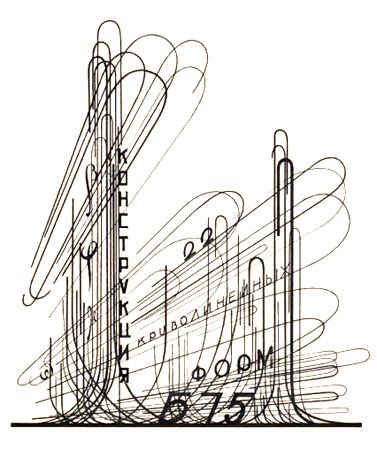
Yes, the work is as fantastic as the name. I was trolling around on my new obsession, Bibliodyssey and came across this post on the aforementioned Russian Constructivist and his incredible synthesis of architecture, typography, and painting. There is a biography here as well as many more images. Chernikhov was called the "Soviet Piranesi" by some, and until his death in 1951 promoted the idea that complexity and a reexamination of detail and even decoration was instrumental to modern design and architecture.

The more I see the more I am certain that I should be selecting my influences rather than attempting revolution.
Yes, the work is as fantastic as the name. I was trolling around on my new obsession, Bibliodyssey and came across this post on the aforementioned Russian Constructivist and his incredible synthesis of architecture, typography, and painting. There is a biography here as well as many more images. Chernikhov was called the "Soviet Piranesi" by some, and until his death in 1951 promoted the idea that complexity and a reexamination of detail and even decoration was instrumental to modern design and architecture.
The more I see the more I am certain that I should be selecting my influences rather than attempting revolution.
Tuesday, July 31, 2007
urban-historical peep show

(Houston, Circa 1891)
The Amon Carter Museum has a fantastic little toy that allows you to browse through an enormous collection of Nineteenth Century bird's-eye views of Texas cities. As they put it:
Bird’s-eye views, many of which are more than three feet wide, appear as something between a panoramic view and a map, as though they were drawn by the artist while he was suspended in a hot-air balloon. In fact, they were drawn by hand using, most often, two-point perspective to produce a three-dimensional rendering. The city views are surprisingly accurate (even to the point of documenting the presence of a tree in the middle of Gonzales Street in Cuero) and represent a much neglected source for understanding the history of Texas.
My only complaint about this website is that the flash browser is so tantalizingly small that I'm left hunched over my screen, eyestrained, scrolling around frantically, tempted by the "buy" link in the toolbar above and cursing the Carter Museum's for not providing (at least low-quality) full size images. But that's beside the point. The fact is, there is no form of art that captures aerial experience better than first-person hand drawings done while levitated. There is something beautiful about the conflict between penciled subjectivity and the exactitude of aerial two-point perspective. But enough said-- go take a look for yourself.
Thursday, July 26, 2007
an internet with less screaming
First of all, I have to point out the even more incredible than usual hodgepodge of etchings and prints over at Bibliodyssey right now. This post has a running start and just keeps speeding up, traveling through "Multi: clown vignettes; SarcoBosco astronomy; Böhme mystical engravings, allegorical book images; satirical Portuguese 19cent illustrations, German tulip and medieval anatomical sketches; ivory manuscript cover; Wisconsin bookart and many, many links." For those of you who haven't been over there, I hope you become as unexpectedly besotted (that's right, besotted) as I am. Those clowns kick ass.
In other news, I recently installed Adblock on my browser. Seeing sites like nytimes and pitchfork media without the relentless distraction of flashing ads bordering every piece of content was so foreign as to make the internet suddenly foreign. It reminded me of the sudden de-ad-ification of Sao Paolo, Brazil, which has left behind a residue like this:

More astonishing images by Tony De Marco can be found here. What both of these (prunings? cleansings?) point out to me is that the removal of commerce from their locales, while a vast improvement, does not lead to a more streamlined or cohesive fabric. The removal of these ads leave huge holes, scar tissue and voids behind. Meaning that advertisements are not additions or accoutrements; once they have been incorporated they are an integral part of a city or medium, and cannot be removed without a violent afterimage. Read even further, the various texts and images on a city are not something that is overlaid and can be changed or removed with impunity; it is integral and deep-rooted. Two recent works of art explore this kind of removal with different results. While Matt Siber's "untitled" project seems to imply that the text is a separate entity, Stinbrener-Dempf's "delete" makes a bright yellow point of the violence implicit in getting rid of city signifiers. I guess this is the base of my thought here-- advertising and signage is not just signifying. It is also an object that has an independent presence from the message it is trying to convey. And it is only after removal that one begins to see how powerful that secondary presence is.
In other news, I recently installed Adblock on my browser. Seeing sites like nytimes and pitchfork media without the relentless distraction of flashing ads bordering every piece of content was so foreign as to make the internet suddenly foreign. It reminded me of the sudden de-ad-ification of Sao Paolo, Brazil, which has left behind a residue like this:
More astonishing images by Tony De Marco can be found here. What both of these (prunings? cleansings?) point out to me is that the removal of commerce from their locales, while a vast improvement, does not lead to a more streamlined or cohesive fabric. The removal of these ads leave huge holes, scar tissue and voids behind. Meaning that advertisements are not additions or accoutrements; once they have been incorporated they are an integral part of a city or medium, and cannot be removed without a violent afterimage. Read even further, the various texts and images on a city are not something that is overlaid and can be changed or removed with impunity; it is integral and deep-rooted. Two recent works of art explore this kind of removal with different results. While Matt Siber's "untitled" project seems to imply that the text is a separate entity, Stinbrener-Dempf's "delete" makes a bright yellow point of the violence implicit in getting rid of city signifiers. I guess this is the base of my thought here-- advertising and signage is not just signifying. It is also an object that has an independent presence from the message it is trying to convey. And it is only after removal that one begins to see how powerful that secondary presence is.
Friday, July 20, 2007
how I miss my Fisher Space Pen
Subtraction is a blog by Khoi Vinh, the design director for the New York Times website. Among other things, he had a recent post on the fact that, unlike other elegantly designed items, most modern electronics, while often being shockingly well designed, are, due to planned obsolescence and somewhat to the current dominant high-tech design philosophy, are doomed to deteriorating inelegantly, if not catastrophically. The question being, why can't our iPods age gracefully, or even improve over time, like cast-iron pans or good luggage? The battered condition of your laptop or cellphone should be a badge of pride instead of an embarrassment.
My contribution to this discussion is that while lots of currently electronics are taking the right first step in divorcing enclosure from content, they all seem to have it backwards, providing interchangeable or replaceable shells for the (currently expensive) interior components. But, as hardware eventually becomes obsolete, why has nobody examined the possibility of creating a long-lasting, beautiful exterior with upgradable guts? There are obvious hurdles like proprietary hardware and no standard dimensions for most components, but some companies have more control over the future of their hardware than others. I'd be perfectly happy with recycling my cellphone hardware once a year, even paying for it, as long as it had a nice, heavy cast-iron shell. As it is, I just have to keep my trashy hinged plastic model for longer than it can really survive.
In a related note, there was a pretty fantastic article in the NYT about planned obsolescence and the unfortunate orphans it leaves in it's wake. Running shoes and digital watches aren't really getting any better, but great designs are often thrown by the wayside instead of being treated as the classics they could be, just so the parent companies can advertise something brand new. Given the iconic power of objects like Converse All-Stars and old-school Casios, it seems that perhaps better attention could be paid to recognising and preserving contemporary common classics. I'll leave you to find the article, but I will point you as far as the comments section, full of New Yorkers grieving for lost gel pens and Honda CRVs. I hope that these people carry on their collective yearning and form a society devoted to the preservation of lost common objects, tiny pieces of locally perfect design that are in danger of being forgotten.
My contribution to this discussion is that while lots of currently electronics are taking the right first step in divorcing enclosure from content, they all seem to have it backwards, providing interchangeable or replaceable shells for the (currently expensive) interior components. But, as hardware eventually becomes obsolete, why has nobody examined the possibility of creating a long-lasting, beautiful exterior with upgradable guts? There are obvious hurdles like proprietary hardware and no standard dimensions for most components, but some companies have more control over the future of their hardware than others. I'd be perfectly happy with recycling my cellphone hardware once a year, even paying for it, as long as it had a nice, heavy cast-iron shell. As it is, I just have to keep my trashy hinged plastic model for longer than it can really survive.
In a related note, there was a pretty fantastic article in the NYT about planned obsolescence and the unfortunate orphans it leaves in it's wake. Running shoes and digital watches aren't really getting any better, but great designs are often thrown by the wayside instead of being treated as the classics they could be, just so the parent companies can advertise something brand new. Given the iconic power of objects like Converse All-Stars and old-school Casios, it seems that perhaps better attention could be paid to recognising and preserving contemporary common classics. I'll leave you to find the article, but I will point you as far as the comments section, full of New Yorkers grieving for lost gel pens and Honda CRVs. I hope that these people carry on their collective yearning and form a society devoted to the preservation of lost common objects, tiny pieces of locally perfect design that are in danger of being forgotten.
Wednesday, July 18, 2007
radio lab
I don't know why things with the word "lab" in them seem to consistently blow my mind, but there's a new one this week. Radiolab isn't a particularly new show (it's the fourth season), but my only exposure up until now was in short segments on KCRW or This American Life. And it is. Awesome. It combines two of my favorite hybrid genres -- the science narrative and humorous documentary -- into a kind of super-melange that keeps me riveted. Jad Abumrad and Robert Krulwich (check out those names) debate socratically and interview supernerds over a consistent blanket of ambient sound in a way that is very. kick. ass.
Monday, July 16, 2007
intermodal fun
One of the things I miss most about grade school is field trips. So the ability to blow off half a day and go on a bona-fide adult field trip was a truly awesome event. We visited the Union Pacific Intermodal Transfer Facility in San Pedro, for kind of hazy and unspecific reasons (which made it all the more fun).

The "facility" is the place where containers are transferred from ship to train (with a tiny interim on a truck in-between). They had built a fairly detailed model of the facility, which was cool, but perhaps a bit of overkill. Check out the tiny little trucks:

After viewing the model we were brought up to a kind of control tower that overlooked the entire yard. Here is where the trucks check into the "ramp" (slang for a transfer yard). I swear every fifth container said Costco on the side. Note the kick-ass refinery beyond.

Here is the area where the transfers take place. Other than trains and trailers, the two main pieces of machinery were the mini-tractors that raced all over the yard pulling trailers next to the trains, and the awesomeAkira-esque gantry cranes that lift the containers into place. A skilled operator can move a container from trailer to train in less than a minute.

There was also some other pretty awesome industrial architecture visible from the tower, like this freakishly monolithic dry-storage "shed," which looked to be as big as a medium-sized Egyptian pyramid.

To the rear of the facility, you could see the source of the thousands of containers the Union Pacific moves every day-- the dockyards. The cranes look massive even from miles away. More field trips will have to be made.


The "facility" is the place where containers are transferred from ship to train (with a tiny interim on a truck in-between). They had built a fairly detailed model of the facility, which was cool, but perhaps a bit of overkill. Check out the tiny little trucks:

After viewing the model we were brought up to a kind of control tower that overlooked the entire yard. Here is where the trucks check into the "ramp" (slang for a transfer yard). I swear every fifth container said Costco on the side. Note the kick-ass refinery beyond.

Here is the area where the transfers take place. Other than trains and trailers, the two main pieces of machinery were the mini-tractors that raced all over the yard pulling trailers next to the trains, and the awesomeAkira-esque gantry cranes that lift the containers into place. A skilled operator can move a container from trailer to train in less than a minute.

There was also some other pretty awesome industrial architecture visible from the tower, like this freakishly monolithic dry-storage "shed," which looked to be as big as a medium-sized Egyptian pyramid.

To the rear of the facility, you could see the source of the thousands of containers the Union Pacific moves every day-- the dockyards. The cranes look massive even from miles away. More field trips will have to be made.

Wednesday, July 11, 2007
screwy
Screw Asylum is a prime example of the internet I fear might evaporate at any moment, the fragile tiny nooks and societies that Ben Katchor invents/documents in his Julius Knipl, Real Estate Photographer series.

Also, the fine people over at SA pointed me to this fantastic Soviet ATV:
Also, the fine people over at SA pointed me to this fantastic Soviet ATV:
Tuesday, July 10, 2007
wii-ta
If one was to make a nerdy blog-post chart, cute pictures of pets would be only slightly above posts about people playing video games. This I realize. But when our dog Rita falls asleep on her back, her little front-paw hooks are just about right shape for wii-mote storage.


Subscribe to:
Posts (Atom)


